
Your barcode is about to become obsolete. By 2027, major retailers will require 2D barcodes and GS1 Digital Link on products across the supply chain, and the clock is ticking for food and beverage manufacturers to get ready.
This isn’t just another retailer mandate. It is a fundamental shift from static identification to dynamic, connected data. For manufacturers still running linear barcodes, the question isn’t whether to upgrade, but how to do it right the first time. Here’s what you need to know.
Why are Manufacturers Hesitant to Upgrade Their ID Systems?
The most common hesitation among clients isn’t the technology itself, but “mandate fatigue.” In industries like food and beverage, suppliers are accustomed to frequent requirements from major retailers like Walmart or Costco. When a new shift like 2D coding emerges, the primary concerns are:
- Compliance Certainty: “Will this meet the requirement exactly as the vendor expects?”
- Legacy Equipment Viability: “Can my current inkjet or labeling system handle high-density data?”
- Future-Proofing: “If I invest now, will I have to buy something else in two years?”
Manufacturers are moving away from a “cost-per-unit” mindset and toward a compliance-first strategy, seeking subject matter experts who can help them buy a solution that meets today’s GS1 requirements while remaining flexible for tomorrow’s innovations.
Direct Print vs. Labeling: Which Technology Wins the 2D Race?
As the industry shifts toward 2D codes (like DataMatrix or QR codes), the method of application becomes critical. While many manufacturers currently use direct print (inkjet) on corrugated boxes, 2D codes introduce new challenges in density and readability.
The Resolution Gap
A typical 2D barcode might need to embed 36 to 48 characters within a 12mm square.
- Inkjet/Direct Print: On corrugated substrates, ink tends to bleed (wicking). This causes dots to merge, making the high-density code unreadable. Furthermore, vibrations or speed variations on the conveyor belt can distort the geometry of the code.
- Labeling Systems: Whether using 203 DPI or 300 DPI, labeling provides a controlled environment. The image is printed on a stable surface before being applied to the box, ensuring crisp edges and high-resolution “A-grade” codes every time.
| Feature | Direct Inkjet Print | Labeling Systems (Print & Apply) |
| Consistency | Subject to belt vibration/speed | Highly controlled print environment |
| Resolution | Limited by substrate bleed | High-resolution (300 DPI available) |
| Data Density | Difficult for small, complex 2D codes | Ideal for high-density GS1 Digital Link |
| Reliability | Variable based on material handling | Consistent, verifiable quality |
| Print Contrast | Blank ink printed on corrugated cases or film overwrap over corrugate will have low contrast, making it hard to read | Black ink printed on white labels is high contrast and easy to read |
How Does 2D Coding Improve Operational ROI?
Moving beyond simple compliance, the shift to 2D codes and automated identification offers a massive boost to traceability and waste reduction. Static G10 barcodes (the 14-digit standard) offer limited information. In contrast, 2D codes allow manufacturers to embed variable data like lot numbers, batch times, and expiration dates.
- Inventory Rotation (FIFO): Instead of just knowing what a product is, systems can now see when it was made. This allows for automated “First-In, First-Out” (FIFO) logic, ensuring older products are moved off the shelves first to prevent spoilage.
- Precision Recalls: In the event of a safety issue (like a foreign object in a batch), 2D coding allows for “surgical” recalls. Instead of pulling product from 20 stores, manufacturers can identify the specific three stores that received the affected lot, saving millions in lost inventory and logistics.
- Inbound Transparency: Modern traceability now extends upstream. Manufacturers can track raw ingredients (e.g., sugar, flour) from the moment they arrive in large sacks to the moment they are packaged into a final box.
Is Your Scanning Technology Ready for the Switch?
The hardware used to read these codes is evolving alongside the barcodes themselves. For decades, the linear laser scanner was the gold standard. However, lasers are limited. They require a physical “swipe” across a linear bar.
Modern facilities are transitioning to Vision Systems (Camera-based). Similar to the technology in a smartphone, these systems take a snapshot of the entire label.
- Multi-Field Reading: A single camera can decode multiple linear barcodes and a 2D code simultaneously.
- Intelligence: Vision systems can discern “bad” codes or missing data in real-time.
- Affordability: Once costing hundreds of thousands, new simple, effective vision systems are now available in the $5,000 to $6,000 range, often integrated directly into the labeling hardware.
Sustainability: Reducing the Carbon Footprint of Identification
As ESG (Environmental, Social, and Governance) goals become a corporate priority, identification technology must adapt. At ID Technology, sustainability isn’t an afterthought. It is built into our labeling solutions. Here are three ways we help manufacturers reduce their environmental footprint:
1. The Shift to Direct Thermal
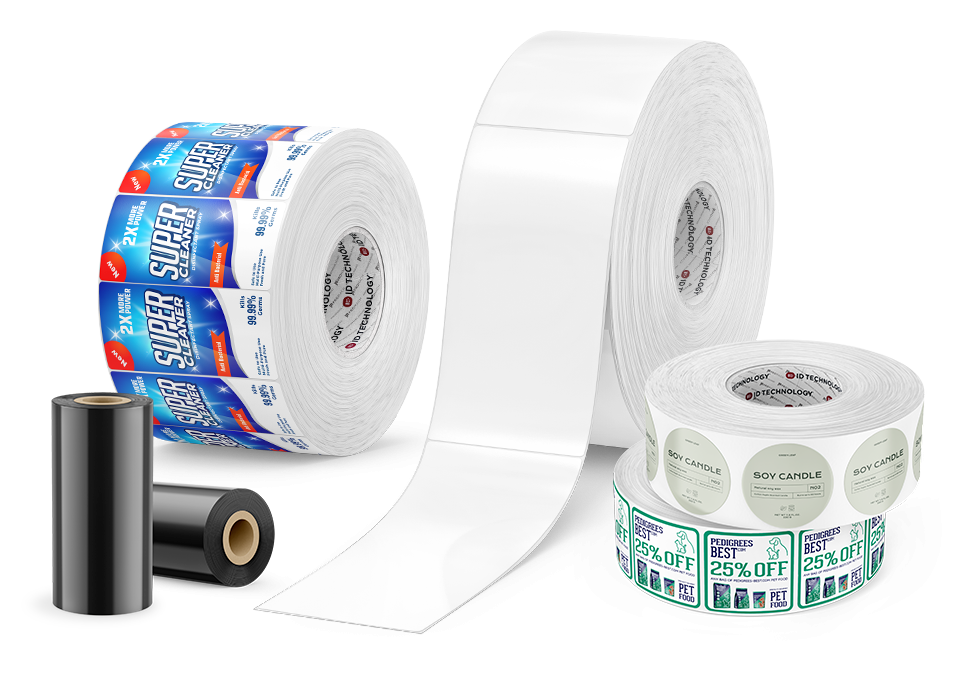
Thermal Transfer technology requires a one-time-use ribbon made of petroleum-based products. For every inch of label used, an inch of ribbon goes to a landfill. Direct Thermal labels have the “ink” baked into the paper, eliminating the ribbon waste entirely.
2. High-Efficiency Materials (EX Liner)
ID Technology offers specialty thin liners (including our EX Liner) that allow for up to 20% more labels per roll.
- Fewer roll changes = Higher uptime.
- Fewer rolls per pallet = Less weight and volume.
- Fewer pallets = Reduced diesel consumption during transportation.
3. Localized Manufacturing
ID Technology operates 10 converting facilities strategically placed across North America, so manufacturers can source labels from a location close to them. This shorter delivery range significantly reduces the carbon footprint associated with long-haul trucking and means faster turnaround times for you.
The “Aha!” Moment: Safety and Total Cost of Ownership
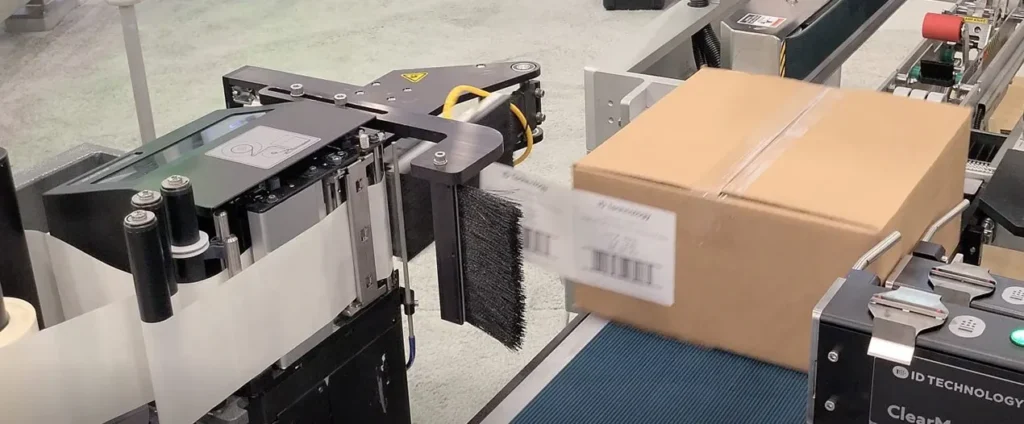
When walking through a facility with an ID Technology rep, the difference between a generic “coding box” and an integrated solution becomes clear during the Service Position demonstration.
Most generic systems are bolted to a “T-base” stand that can be bumped, misaligned, or create trip hazards. ID Technology’s integrated labeling systems feature a Service Position Stand, which allows the machine to rotate away from the production line.
The Result: The operator can safely reload labels or clean the print head without being squeezed between a running conveyor and a heavy machine.
Reliability and Maintenance
Reliability isn’t just about the machine; it’s about the process. ID Technology includes cleaning wipes with every roll of labels to encourage operators to maintain the print head. A clean print head lasts longer, which reduces the Total Cost of Ownership (TCO) and prevents the “cascading failures” common in cheaper, unmaintained systems.
Preparing for 2027
The transition to 2D barcodes and GS1 Digital Link is more than a technical hurdle; it is a strategic opportunity to digitize the supply chain. By choosing labeling over direct print, adopting vision-based scanning, and focusing on sustainable, operator-friendly hardware, manufacturers can turn a mandate into a competitive advantage.
Are you ready for the shift? The goal is to be more efficient, more sustainable, and more transparent than ever before.
Key Takeaways for Your Next Facility Walkthrough:
- Evaluate your substrate: Does your corrugated box allow for high-density inkjet, or do you need a label for 2D clarity?
- Check your scanners: Are you still relying on linear lasers that can’t read 2D codes?
- Assess operator safety: Can your team access the equipment without stopping the line or risking injury?
- Audit your waste: Are you throwing away miles of thermal ribbon that could be eliminated with direct thermal tech?
 Labeling & Coding News is the online industry insider from ID Technology, EPI , Panther, Greydon, and Code Tech Labeling & Coding product brands of ProMach.



